
You already know insurance is one of the most competitive paid advertising markets on the planet. Keywords like “life insurance quotes” and “auto insurance near me” can cost $30 to $80 per click on Google. And if your campaigns aren’t dialed in, you’re burning through budget on clicks that never convert.
Here’s the truth: most insurance agents aren’t losing to bigger budgets. They’re losing to better strategy. The agents who are closing more policies with paid search and paid social aren’t necessarily spending more. They’re spending smarter.
This is your playbook.
Why Paid Advertising Is Non-Negotiable for Insurance Agents
Organic search for insurance is dominated by aggregators like NerdWallet, Policygenius, and the carrier websites themselves. Ranking organically takes years. Paid advertising gives you a direct line to high-intent buyers right now.
Consider the numbers: insurance is consistently ranked among the top five most expensive industries for Google Ads, with average CPCs ranging from $15 to $80 depending on the line of business (WordStream, 2026). But the lifetime value of a single client, across auto, home, life, and umbrella policies, can easily exceed $10,000 to $20,000 over a relationship. The math works. The problem is most agents never get the math right because their campaigns are set up wrong from the start.
Paid Search: The High-Intent Engine
Google Ads and Microsoft Ads are where buyers go when they are actively shopping. Someone searching “independent insurance agent near me” or “best homeowners insurance quote” is ready to talk. That is the traffic you want.
Start with the right campaign structure. Separate your campaigns by line of business. Auto, home, life, commercial, and health should each have their own campaign with their own budget, ad groups, and keywords. Mixing them together dilutes your Quality Score and drives up your cost per click.
Keyword match types matter more than most agents realize. Broad match in a competitive market like insurance will drain your budget on irrelevant traffic. Start with phrase match and exact match keywords. Build a strong negative keyword list from day one. Terms like “free,” “jobs,” “license,” “exam,” and carrier brand names you don’t represent should be excluded immediately.
Your landing page is where campaigns win or lose. Sending paid traffic to your homepage is one of the most common and costly mistakes in insurance advertising. Every campaign needs a dedicated landing page that matches the ad’s message, loads in under three seconds, and has one clear call to action: get a quote or schedule a call. Google’s Quality Score rewards relevance between your ad, your keywords, and your landing page. Higher Quality Scores mean lower CPCs and better ad placement.
Local Services Ads (LSAs) are underutilized by insurance agents. LSAs appear above standard Google Ads and operate on a pay-per-lead model rather than pay-per-click. For independent agents, LSAs can deliver qualified leads at a lower cost per acquisition than traditional search campaigns. If you are not running LSAs alongside your search campaigns, you are leaving top-of-page real estate on the table.
Paid Social: The Awareness and Retargeting Engine
Facebook and Instagram ads work differently than search. People on social media are not actively shopping for insurance. They are scrolling. Your job is to interrupt the scroll with something relevant enough to make them stop and act.
Targeting is your biggest advantage on paid social. Unlike search, where you are bidding on intent signals, social platforms let you target by demographics, life events, behaviors, and interests. New homeowners, recently married couples, parents of newborns, and small business owners are all high-value insurance audiences you can reach with precision.
Facebook’s life event targeting is particularly powerful for insurance. Someone who just bought a home is actively thinking about homeowners insurance. Someone who just had a baby is thinking about life insurance. Reaching them at that exact moment with a relevant message is the difference between a scroll-past and a lead.
Lead generation ads outperform link clicks for insurance. Facebook and Instagram Lead Ads allow prospects to submit their contact information without ever leaving the platform. The form pre-fills with their profile data, reducing friction dramatically. For insurance agents, this means more leads at a lower cost per lead compared to driving traffic to an external landing page.
Retargeting is where the real money is. Most people who visit your website or engage with your ads are not ready to buy on the first touch. Retargeting campaigns keep your agency in front of warm prospects across Facebook, Instagram, and Google’s Display Network. A prospect who visited your auto insurance page and then sees your retargeting ad three days later is far more likely to convert than a cold prospect. Set up retargeting audiences for website visitors, video viewers, and lead form openers who did not complete the form.
The Full-Funnel Approach: How to Put It Together
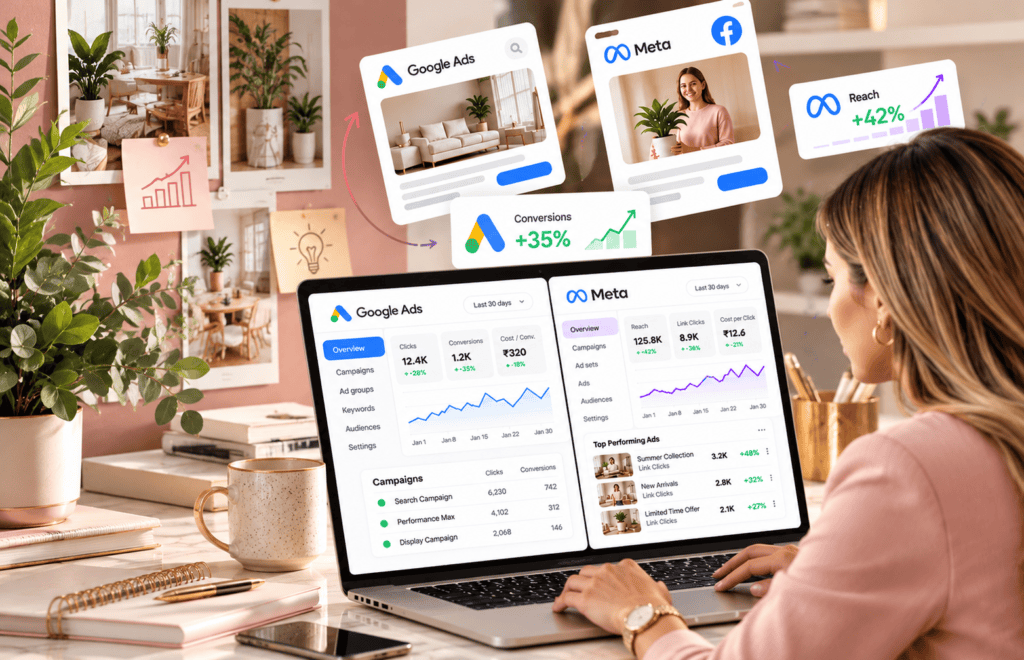
The agents who win with paid advertising are not running search OR social. They are running both, in a coordinated system.
Here is how the funnel works: Facebook and Instagram ads build awareness and capture leads from audiences who match your ideal client profile. Google Search and LSAs capture high-intent buyers who are actively shopping. Retargeting across both platforms re-engages everyone who showed interest but did not convert. Email follow-up sequences nurture leads who are not ready to buy today.
Each layer of the funnel feeds the next. Without awareness, your search campaigns only reach people who already know to look for you. Without retargeting, you lose the majority of your paid traffic after the first visit.
What to Track and What to Cut
Paid advertising without tracking is just spending. Every campaign needs conversion tracking set up before you spend a dollar. For insurance agents, conversions are quote requests, phone calls, and form submissions.
Track cost per lead by campaign, by line of business, and by platform. If your auto insurance Google Ads campaign is generating leads at $45 each and your life insurance campaign is generating leads at $120 each, those campaigns need different strategies. Do not average them together and call it a day.
Cut keywords, ad sets, and audiences that have spent more than two to three times your target cost per lead without converting. Paid advertising rewards ruthless optimization.
The Bottom Line
Insurance is expensive to advertise in. That is not changing. But the agents who build a structured, full-funnel paid advertising system, with the right campaign architecture, targeted social ads, and relentless optimization, consistently outperform competitors who are spending more but thinking less.
You do not need a massive budget to compete. You need a better strategy.
FairBloom builds and manages paid advertising systems for insurance agents who are ready to stop overpaying for leads and start closing more policies. If you are ready to put a real system behind your ad spend, let’s talk.
From Leads to More Closed Policies
At FairBloom, we build done-for-you email marketing systems for local service businesses – from list setup and automation to seasonal campaigns and reactivation sequences. If you’re ready to turn your customer list into a recurring revenue machine, let’s talk.
- Contact FairBloom Marketing
- 561-466-3822