
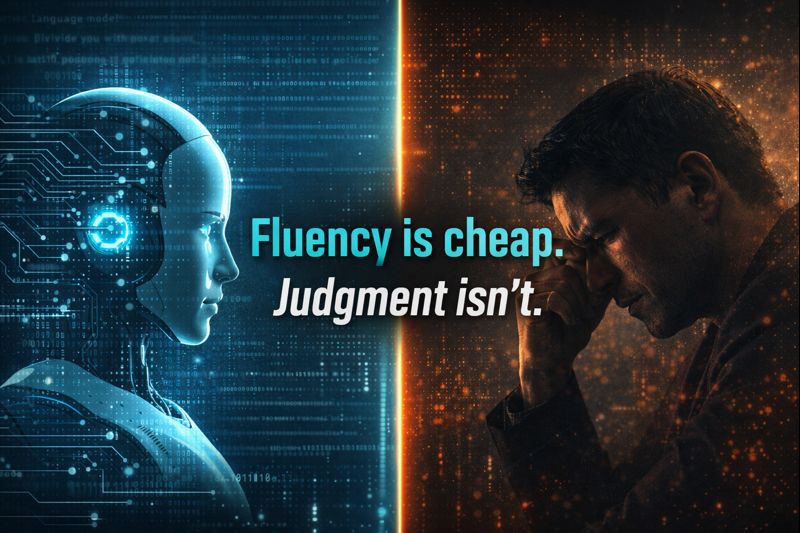
For decades, professional culture relied on a simple heuristic: fluency meant competence.
If someone spoke smoothly, confidently, and quickly, we assumed they were prepared, capable, and experienced. In environments where communication skills were hard-earned and easily disrupted under pressure, that assumption worked well enough.
That world no longer exists.
Today, fluency is abundant.
Artificial intelligence is fluent.
Scripts are fluent.
Leadership training programs are fluent.
When a signal becomes abundant, it loses its value.
What has not become cheap is judgment.
This article examines a fundamental shift in leadership evaluation happening beneath the surface of modern organizations: the decline of fluency and performative authenticity as reliable leadership signals, and the rise of credibility, traceable thinking, and early risk perception. It also explores why neurodivergent leaders are particularly well-suited for this shift, and why organizations that ignore them do so at their own risk.
When Fluency Stops Meaning Competence
Fluency rewards speed.
In many workplaces, the first confident answer is treated as decisiveness. The cleanest narrative is treated as clarity. Silence is treated as uncertainty.
Over time, this creates a predictable incentive structure.
Leaders learn to:
- commit early rather than think fully
- defend decisions instead of revisiting assumptions
- optimize how decisions sound instead of how they hold up
Fluency trains people to perform with certainty.
Judgment introduces friction.
Judgment pauses before commitment.
Judgment revises mid-thought.
Judgment resists oversimplified answers.
Judgment considers downstream consequences before language hardens into policy.
These behaviors slow conversations down. They make rooms uncomfortable. They interrupt momentum.
They are also where durable leadership decisions are made.
As artificial intelligence raises the baseline for polish and articulation, fluency becomes easier to manufacture and harder to trust. Leaders who rely on it as proof of competence increasingly find themselves indistinguishable from automation and from people trained to imitate it.
If a leadership signal can be replicated by a language model, it is no longer a meaningful signal.

Why Fluency Fails Under Pressure
The limits of fluency become most visible when the stakes rise.
Highly fluent leaders often struggle in moments of real consequence because fluency conditions people to avoid hesitation at all costs. Under pressure, this conditioning shows up as:
- Doubling down instead of recalibrating
- Filling the silence instead of using it
- Mistaking decisiveness for correctness
- Escalating commitment to fragile decisions
In cultures that reward speed, pausing feels unsafe. Yet hesitation is often the only thing standing between a bad decision and an irreversible one.
Fluency optimizes for sounding right.
Judgment optimizes for not being wrong.
As systems become more complex and consequences more distributed, that distinction matters more than ever.
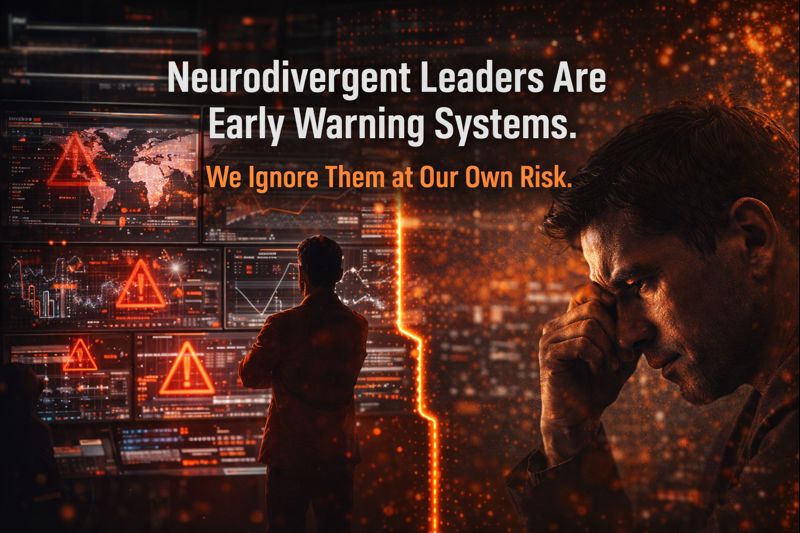
Neurodivergent Leaders as Early Warning Systems
This is where neurodivergent leadership comes into play.
Across industries, neurodivergent leaders are often described as “too much.”
Too detailed.
Too intense.
Too focused on edge cases.
Too unwilling to let things slide.
These labels tend to appear shortly before systems fail.
Many neurodivergent people have heightened pattern sensitivity. They notice:
- inconsistencies between stated values and actual behavior
- incentives that quietly reward the wrong outcomes
- processes that only work under ideal conditions
- risks that consensus has learned to ignore
This is not pessimism. It is a structural perception.
Where others see stability, neurodivergent leaders often see load-bearing weaknesses. Where others see alignment, they see unresolved risk.
The problem is not perception. The problem is how organizations reward comfort.
Why Organizations Silence Early Warning Signals
Most organizations are optimized for reassurance rather than accuracy.
They reward leaders who:
- Reduce uncertainty quickly
- Provide clean narratives
- Project confidence
- Maintain morale
Early warnings disrupt all of that.
They introduce friction.
They slow the momentum.
They force people to confront tradeoffs they would rather postpone.
As a result, the messenger becomes the problem.
Neurodivergent leaders are reframed as difficult, negative, or misaligned, not because they are wrong, but because they are early.
By the time warnings become socially acceptable to acknowledge, they are no longer warnings. They are postmortems.
This is why organizations so often ask, after failure, “Why didn’t anyone say something?”
In many cases, someone did.
They were told to stop overthinking, trust the process, be more positive, wait for more data, or sound more confident.
Over time, many neurodivergent leaders learn that speaking early carries social cost. Many go quiet.
That silence is expensive.

From Authentic Leadership to Credible Leadership
For the past decade, leadership discourse has emphasized authenticity.
Be authentic.
Lead authentically.
Show up as your authentic self.
The instinct behind this advice was humane and well-intentioned. But authenticity only functions as a leadership signal when it is voluntary.
The moment vulnerability becomes expected, authenticity becomes performative.
Today, leaders can:
- Sounds vulnerable without being accountable
- Express emotion without changing behavior
- Curate sincerity for approval or safety
- Perform empathy without assuming responsibility
Artificial intelligence did not create this problem. It exposed it.
When machines can convincingly simulate tone, empathy, and reflection, authenticity stops distinguishing humans from automation.
What organizations are actually seeking is credibility.
What Credibility in Leadership Really Means
Credibility is not about how real someone sounds.
It is about whether people can rely on them when:
- Decisions are unpopular
- Tradeoffs are unavoidable
- Information is incomplete
- Pressure is high
- No one is applauding
Credible leaders demonstrate:
- consistency under stress
- alignment between stated values and behavior
- boundaries that hold even when inconvenient
- decisions that can be traced, not merely justified
Authenticity focuses on expression.
Credibility focuses on consequences over time.
One can be performed.
The other must be earned.
Why Neurodivergent Leaders Excel in Credibility-Based Leadership
Many neurodivergent leaders are uncomfortable with performative authenticity.
They do not instinctively overshare.
They resist emotional theater.
They prioritize clarity over catharsis.
This has often been misinterpreted as coldness or lack of charisma.
In reality, it reflects boundary integrity.
Neurodivergent leaders tend to:
- Say less, but mean it
- Explain decisions rather than emote about them
- Build trust through consistency rather than disclosure
This makes them poor performers in authenticity-driven leadership cultures.
It also makes them strong anchors in credibility-driven ones.
Transparency does not require total visibility. Credible leaders share what people need to orient themselves and withhold what would confuse or destabilize. This is not secrecy. It is stewardship.
The Future of Leadership Evaluation
Authentic leadership asks, “Do you feel like I’m real?”
Credible leadership asks, “Can you depend on me?”
As organizations navigate AI, automation, and increasing complexity, the second question becomes more important than the first.
The leaders who will matter next are not the most expressive. They are the most consistent.
They pause when decisions carry cost.
They revise when assumptions break.
They resist collapsing complexity for comfort.
They allow thinking to remain visible.
In a post-synthetic world, friction is becoming the clearest signal of reality.
Leadership After Fluency
Fluency is easy to optimize.
Authenticity is easy to perform.
Judgment is not.
Credibility must be earned through behavior that holds when narratives fail, emotions do not land, and decisions have irreversible consequences.
Leadership in the age of artificial intelligence will belong to those who understand the difference.